 Arashiyama Bamboo Forest
Arashiyama Bamboo Forest Photos: The 8 Spots, and the Lane You Cannot Walk
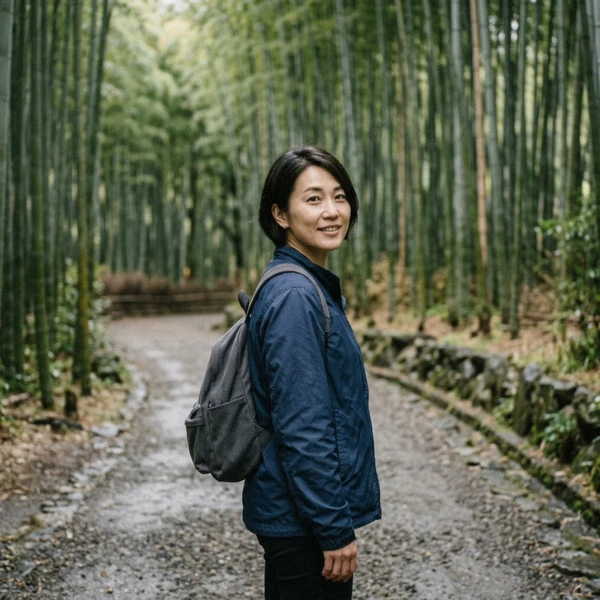
Most Arashiyama bamboo forest photos come from one of three places: the first 100 metres of the main path before 8:00, the railway crossing halfway up that almost nobody continues to, and a private rickshaw lane that walkers are not allowed to enter. That last one explains why your photograph does not look like the one that made you come. Our Arashiyama Bamboo Forest guide covers the visit itself. Below are the eight frames worth walking to, each with the clock window that works, what it costs, and a map that shows where they actually are.
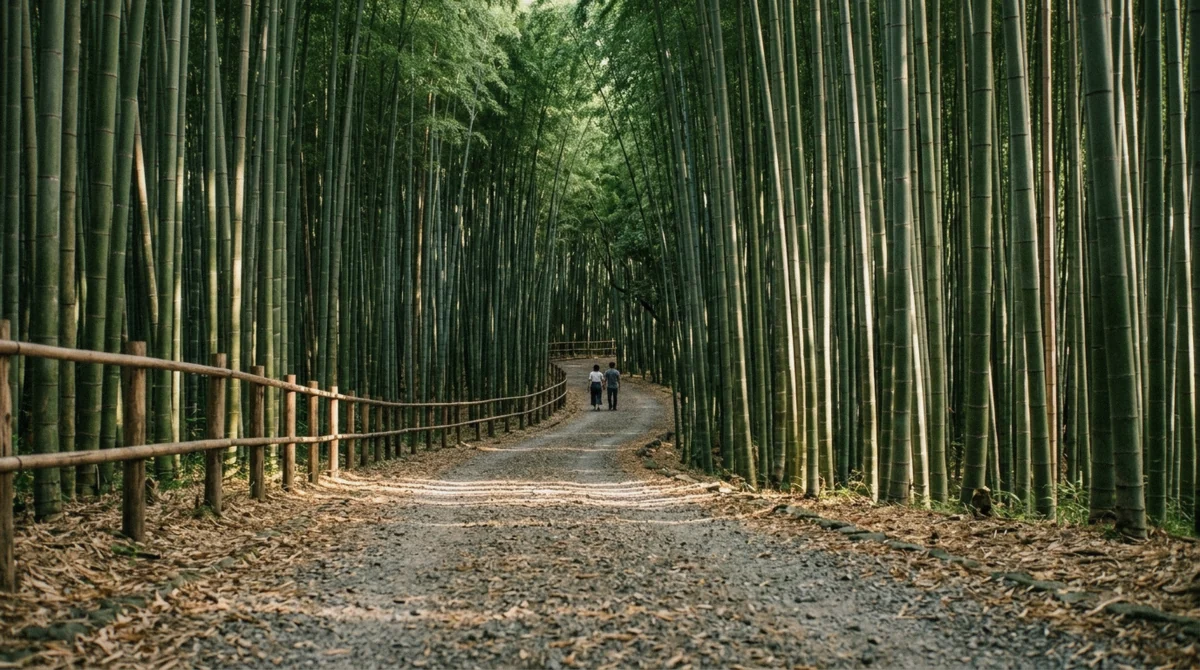
Quick answer
The best photograph in the Arashiyama Bamboo Forest is taken on the main path between Nonomiya Shrine and the Okochi-Sanso gate, before 8:00, looking uphill so the culms converge. The second-best, and much quieter, is the stretch beyond the Sagano railway crossing that most visitors never reach. The frames with bamboo pressing in from both sides come from a rickshaw-only lane, closed to people on foot, which costs ¥9,000 for thirty minutes.
Key takeaways
- Be on the path by 07:30. By 10:00 no frame is free of people.
- Overcast and light rain beat direct sun, which blows out the gaps between culms.
- The quiet half is past the railway crossing at the top of the main path.
- The tight both-sides-bamboo frame is rickshaw-only, ¥9,000 for one passenger.
- Tripods get you moved on at busy hours; drones are banned outright.
- Free spots: the grove, Nonomiya, the crossing, the bridge, the Kimono Forest at dusk.
The Spots at a Glance
Eight frames, in the order you would walk them from JR Saga-Arashiyama. Times are the clock windows that work, not opening hours.
| Spot | Best window | The shot you get | Cost |
|---|---|---|---|
| Main path, lower section | 07:00 to 08:00 | Converging culms, low side light on gravel | Free |
| Nonomiya Shrine | 07:30 to 09:00 | Black torii gate against green, no wide crowd | Free |
| Sagano railway crossing | 07:00 to 09:00 | Track cutting through bamboo, anime framing | Free |
| Upper path beyond the crossing | Any time before 15:00 | Empty corridor, the frame everyone misses | Free |
| Okochi-Sanso garden | 09:00 to 10:30 | Bamboo above, city and hills below, moss | ¥1,000 |
| Tenryu-ji Sogenchi pond | 08:30 opening | Still reflection of the hillside, no crowd yet | ¥500 |
| Togetsukyo Bridge | Sunset | 155 m span, mountains behind, river foreground | Free |
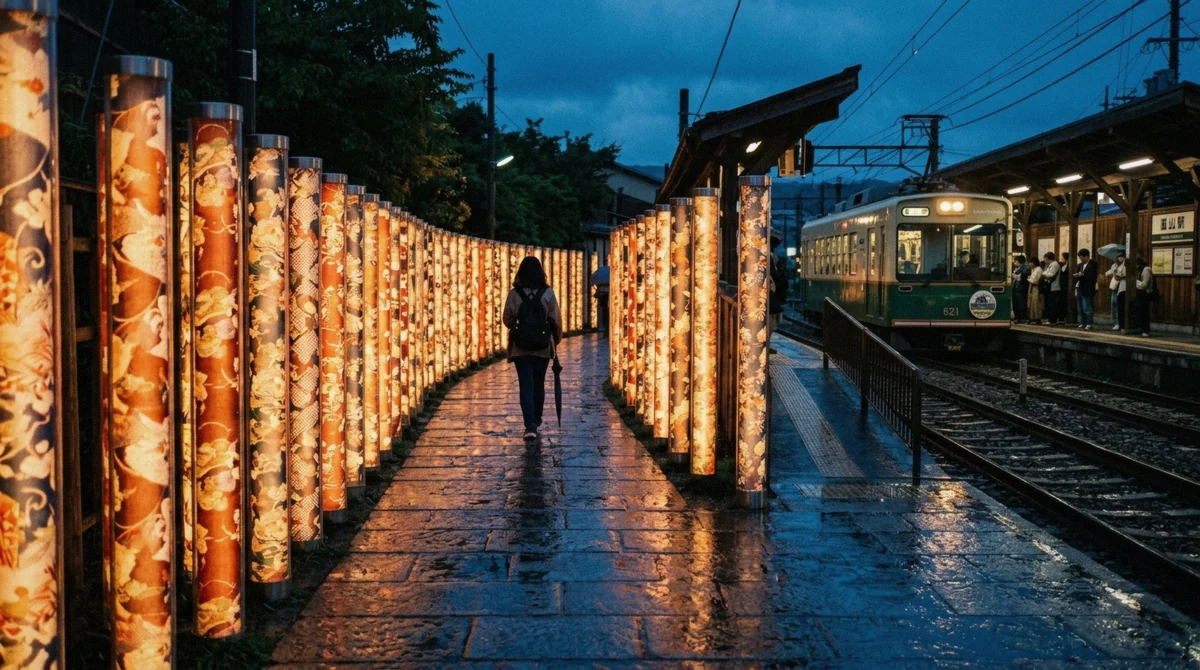
| Kimono Forest | Dusk onward | 600 lit fabric pillars, wet paving after rain | Free |
Map of the Photo Spots
Numbered in walking order from JR Saga-Arashiyama. The rickshaw lane is marked because it is the one you will look for and cannot use.
The Frames, One by One
1. The main path, shot uphill
Start at the southern entrance near Nonomiya and shoot back up the slope rather than down it. The path narrows as it climbs, so the culms converge and the gravel leads the eye; the reverse angle flattens everything.
The window is brutal and short. At 07:00 you have it to yourself. At 08:00 there are perhaps ten people and gaps to wait for. By 09:30 a clean frame requires patience most visitors do not have, and by 10:00 it is gone until late afternoon.
The grove sits at 35.0168°N, 135.6716°E if you are dropping a pin for a pre-dawn taxi, and the southern entrance is the one closest to Nonomiya Shrine.
2. Nonomiya Shrine
The shrine at the south entrance carries a black wooden torii, the kuroki style, standing against a wall of green. It photographs well precisely because it gives the eye something dark and geometric in a frame that is otherwise all vertical lines.
It is a working shrine with people praying at it, so keep back from the offering hall and do not photograph anyone at the water basin.
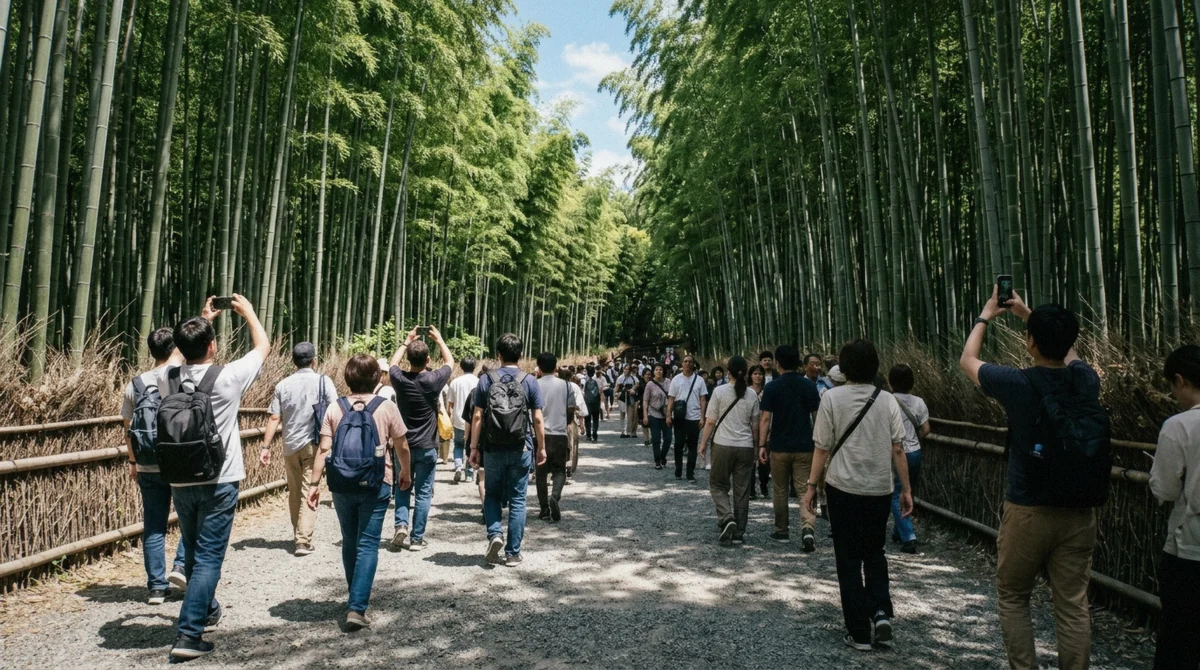
The same path at midday. No amount of camera skill fixes this frame.
3. The Sagano railway crossing
Halfway up the main path, a single track cuts across the grove at a level crossing. Bamboo on both sides, rails vanishing into it, and if you wait a few minutes a Sagano train comes through. It is the most cinematic frame in Arashiyama and most people photograph the crossing sign and walk on.
Stand well back from the rails, keep off the track bed, and let the barriers do their job. Trains here run from 9:02, so an early start means waiting or coming back.
4. The upper path, past the crossing
Cross the track and the crowd halves, then halves again. This upper stretch has the same bamboo and almost none of the people, because the majority of visitors turn around at the Okochi-Sanso gate and walk back down.
If you arrive late and everything below is a queue, this is where to go. At 14:00 on a Saturday it is still walkable, which is not true of anywhere else in the grove.
5. Okochi-Sanso Villa
The ¥1,000 ticket at the top of the path buys twenty thousand square metres of hillside garden with moss, stone lanterns, bamboo along the upper paths and a viewpoint over the whole of Kyoto. It is the only place in the district where you get bamboo and a wide landscape in the same frame.
It also has the crowd problem solved for you: the ticket price alone thins the flow to a trickle. Keep the stub, since it is what you exchange for matcha at the teahouse.
6. Tenryu-ji's Sogenchi pond
Be at the gate when it opens at 08:30, pay ¥500, and walk straight to the pond. For about fifteen minutes the water is still and the hillside behind it reflects cleanly, before enough people arrive to put ripples and hats in the picture.
This is also the smartest route into the grove: leave by the temple's north gate and you enter the bamboo path halfway along, past the bottleneck at the southern entrance.
7. Togetsukyo Bridge at sunset
The 155 metre Moon Crossing Bridge, Heian in origin and rebuilt in the 1930s, sits with the Arashiyama mountains directly behind it. Shoot from the north bank looking south-west in the last half hour of light, with the river taking the colour of the sky.
In November the hillside behind the bridge turns and this becomes the most photographed frame in western Kyoto, which is worth knowing before you plan on having space to set up.
8. The Kimono Forest at dusk
Ten minutes from the grove, the tram station is ringed by about 600 pillars of Kyo-yuzen fabric with an LED inside each one. In daylight it is a curiosity; after dark it is the best colour photograph in the district and there is nobody there, because the day crowd has gone home.
Rain makes it: the wet paving doubles every pillar. Details are in our guide to the Kimono Forest.
The Lane You Cannot Walk
The photograph in your head, the one where bamboo presses in from both sides with no gap and no people, is usually taken on a narrow lane inside the grove that is reserved for rickshaw passengers. Walkers are not permitted on it. That is not a rule anybody publicises and it is the single most common source of disappointment here.
Ebisuya runs the service, at ¥9,000 for one passenger or ¥10,000 for two on a thirty-minute Bamboo Forest course, roughly $57 and $64. The drivers stop at the good points and photograph you with your own camera, which is most of what you are paying for. Whether that is worth two-thirds of a guided half-day tour is a judgement only you can make, but at least make it knowing the lane exists.
Everything else in the grove is open to anyone at any hour, which our guide to the Arashiyama Bamboo Forest lays out in full, along with the walks that reach the path before the crowd.
Settings, Weather and Rules
The grove is a high-contrast subject in bright sun and an easy one under cloud. Overcast days and light rain produce the even, saturated green that the postcards have; midday sun punches white holes between the culms that no editing recovers.
- Shoot wide, 16 to 24 mm equivalent, and get low to exaggerate the height
- Under cloud, expose for the highlights between the stalks and lift the shadows later
- Phones: turn off the ultra-vivid photo modes, which turn bamboo an unnatural yellow-green
- A polariser cuts the sheen off wet leaves and deepens the green more than any slider
- Blue hour, 20 to 30 minutes after sunset, is the last usable light without a tripod
Etiquette that is actually enforced
Tripods block a path that is barely two people wide, and at busy hours staff and residents will ask you to move on. Drones are prohibited in the grove at any hour. The bamboo is living property of the temples and the households whose gardens back onto it, and carving initials into culms has become common enough that signs now name it in four languages.
None of this is heavy-handed by Kyoto standards. Turn up early, keep the tripod folded when the path fills, and nobody will trouble you.
For the timing behind all of this, our hour-by-hour guide to the Arashiyama Bamboo Forest sets out when each window opens and closes.
Settings that work, by frame
Nothing here needs an expensive camera. It needs the right exposure decision for a subject that is mostly vertical lines in mixed light.
| Frame | Light | Settings that work |
|---|---|---|
| Main path uphill | Overcast or early side light | f/5.6, ISO 400, shoot 1 stop under and lift shadows |
| Railway crossing | Early morning, train approaching | 1/500s or faster, prefocus on the rails |
| Upper path | Any daylight | Wide open at f/2.8 to separate the near culms |
| Okochi-Sanso view | Mid-morning haze | Polariser on, expose for the city below |
| Togetsukyo at sunset | Last 30 minutes | f/8, ISO 100, brace on the railing |
| Kimono Forest | After dusk | ISO 1600, 1/60s, tap-to-expose on a lit pillar |
If you only get the middle of the day
Plenty of visitors reach Arashiyama at noon because a train from Osaka or a morning temple ran long. The frames that still work then are the upper path beyond the crossing, the Okochi-Sanso garden where the ticket price thins the crowd, and the Sogenchi pond at Tenryu-ji from an angle that keeps the far bank in the water.
What does not work is the lower main path, at any focal length, with any amount of patience. Come back for it at 16:30, when the coach groups leave and the light turns sideways, or accept that your bamboo photograph will have forty people in it. Timing is covered hour by hour in our timing guide, and the fee breakdown covers which of these spots charge.
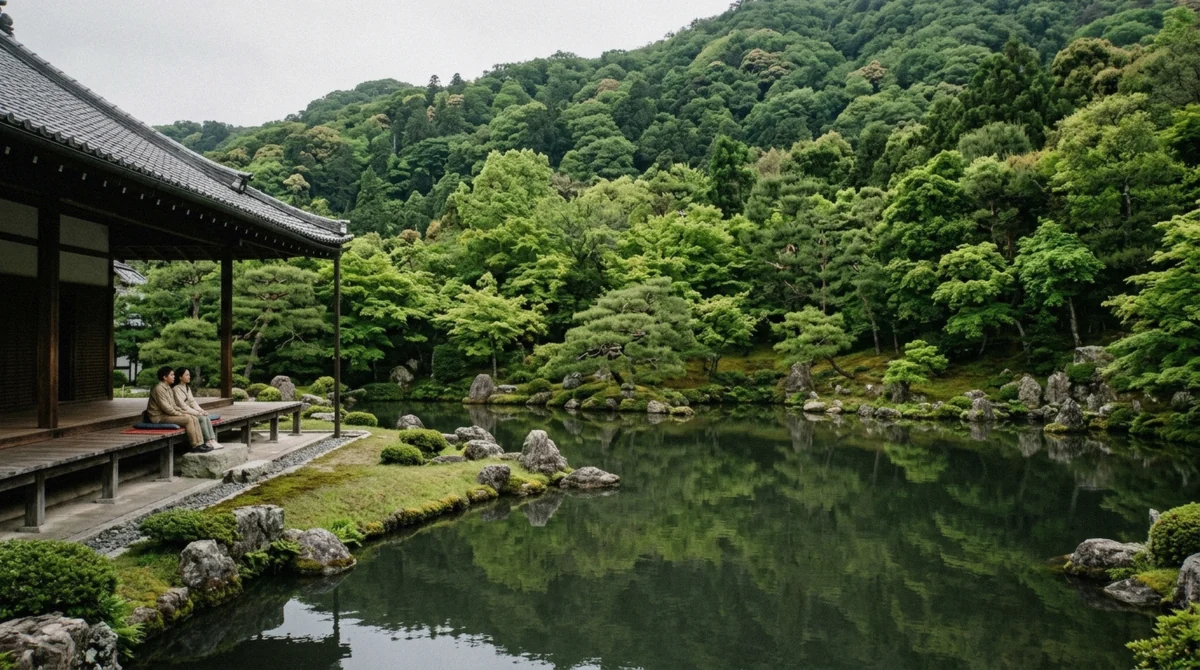
Sogenchi pond at 08:35, before the water picks up ripples and hats.
The one frame here that improves after dark, and the only one that rain makes better.
Photography Questions People Ask
What is special about Arashiyama Bamboo Grove?
Scale and sound. The mōsō culms run 15 to 20 metres up and lean over the path, so the light arrives green and moving, and the noise the stalks make in wind put this grove on the Ministry of the Environment's list of the 100 Soundscapes of Japan. Photographically it is one of the few places where a plain gravel path is the whole composition.
What time should you photograph the bamboo forest?
Between 07:00 and 08:00. That is the only window with usable light and no crowd. The last hour before sunset is the fallback, quieter than midday though dimmer under the canopy. Between 10:00 and 15:00 there is no clean frame at any focal length.
Why do my photos not look like the famous ones?
Two reasons. The tightest bamboo-on-both-sides frames come from a rickshaw-only lane that walkers cannot enter, and most of the glowing night images date from ticketed illumination events rather than a normal evening. The public path in daylight is wider and busier than the pictures suggest.
How long does it take to walk through bamboo forest Kyoto?
Ten to fifteen minutes on the main path, half an hour if you continue past the railway crossing and stop to shoot. For photography, budget an hour to work the lower path, the shrine and the crossing properly before the crowd arrives.
What to wear to Arashiyama Bamboo Forest?
Shoes with grip, because the path is loose gravel and gently uphill, and layers, since the grove sits several degrees cooler than the open riverbank. If you are shooting at dawn in winter, add gloves: the canopy holds the cold and your hands go first.
Are drones or tripods allowed?
Drones are banned in the grove and at the monkey park. Tripods are not formally prohibited but block a two-person-wide path, so expect to be asked to move once the crowd builds after 09:00. Before 08:00 nobody minds.
Is Arashiyama Bamboo Forest worth visiting for photographers?
Yes, if you accept the early start. Free entry, no ticket to time, eight distinct frames within a fifteen-minute walk and a lit installation at the tram station for after dark. Turn up at 10:00 and it is one of the least rewarding places in Kyoto to hold a camera.