 Arashiyama Bamboo Forest
Kimono Forest: Kyoto's Best Free Ten Minutes
The Kimono Forest is what happens when a tram company renovates a station and hires an interior designer instead of an engineer. Around the platforms at Randen Arashiyama stand about 600 pillars, each two metres high, each sleeved in Kyo-yuzen dyed silk under clear acrylic, each lit from inside after dark. It costs nothing, it has no gate and no closing time, and it takes ten minutes to walk. Most visitors pass through it on the way to the Arashiyama Bamboo Forest without knowing it has a name.
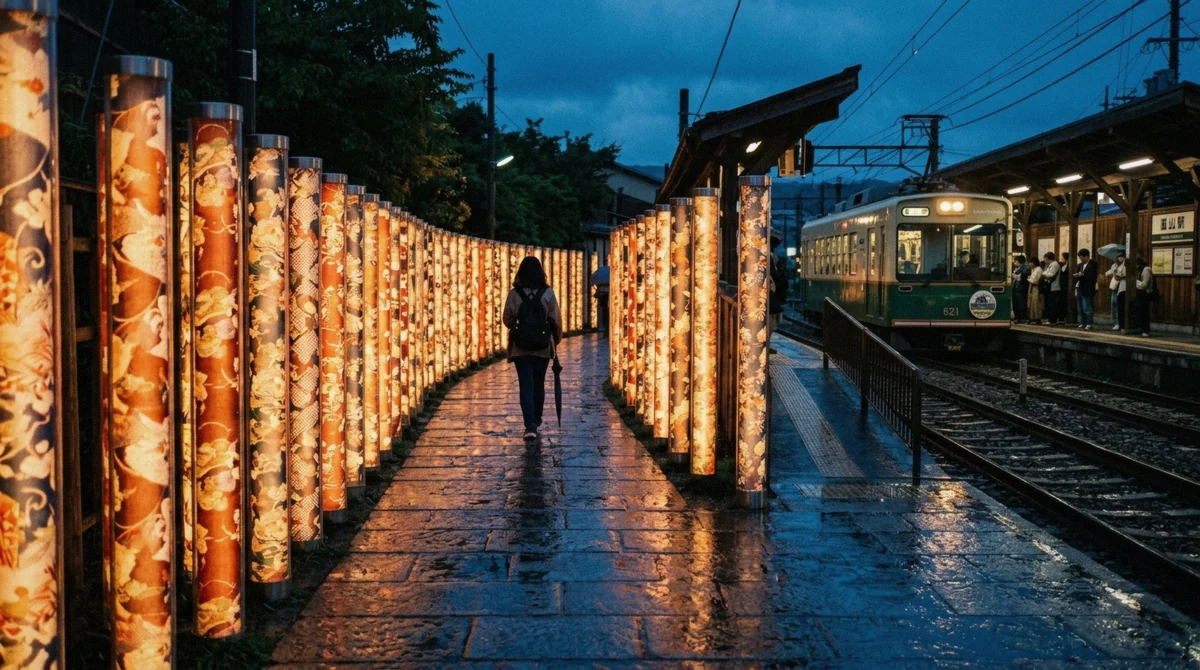
The pillars after rain, when the paving doubles every light in the installation.
Quick answer
The Kimono Forest is a permanent art installation of about 600 fabric-wrapped pillars around the platforms of Randen Arashiyama Station in Kyoto, installed during the station's 2013 renovation. Entry is free, there is no gate and no closing time, and walking the full loop takes 10 to 15 minutes. Each pillar holds an LED, so the installation only becomes what the photographs promise once the light goes.
Key takeaways
- Free, unfenced, open at any hour. No ticket exists for this.
- About 600 pillars, 2 metres tall, in 32 different Kyo-yuzen patterns.
- Best after dusk, when the internal LEDs light every pillar.
- Fifteen minutes on foot from the bamboo grove, so both fit in one visit.
- The Randen tram to this station is a flat ¥250 from central Kyoto.
- One guided walk builds it into the route, three hours at $70.
The Walk That Includes It
Guides mostly skip the Kimono Forest because it needs no explaining and no ticket. One three-hour walk puts it on the route between the grove and the bridge.
 from $70
Kimono Forest Included — 5.0★
from $70
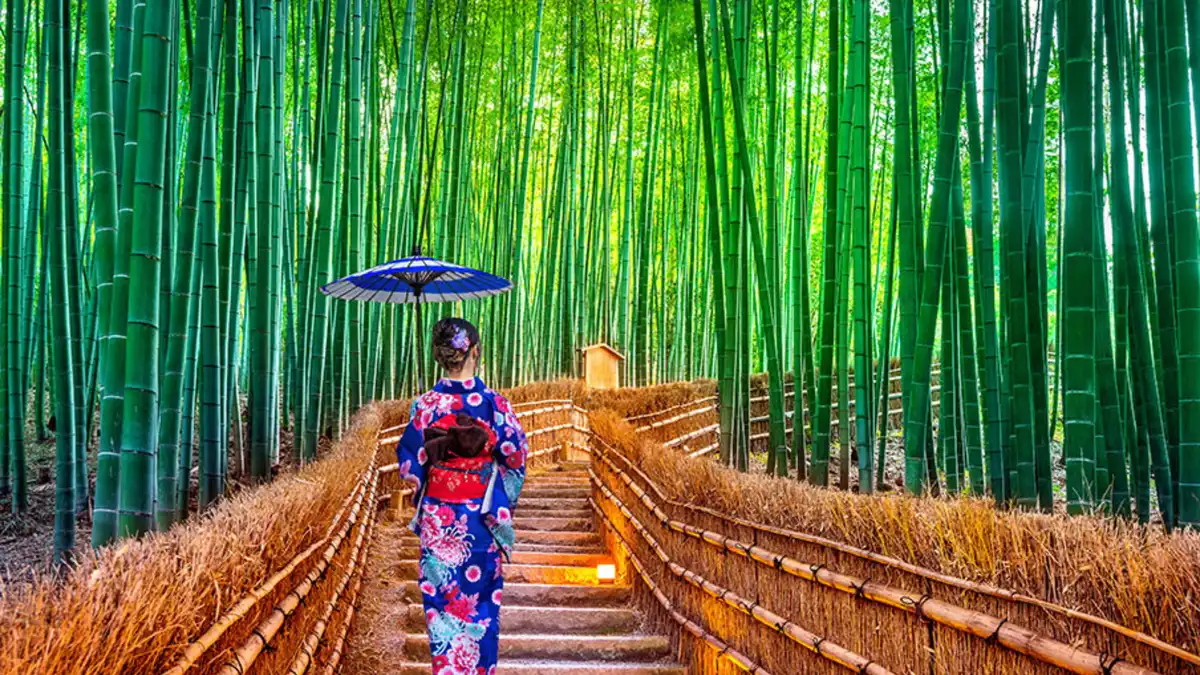
Kimono Forest Included — 5.0★ Arashiyama Walking Tour: Bamboo Grove, Kimono Forest and Monkey Park
A newer, shorter three-hour walk with a perfect score from its first handful of travellers. It is the only tour here that builds the Kimono Forest, the 600-plus…
- Only tour here that walks the Kimono Forest's 600 illuminated pillars
- Three hours, the shortest full circuit of the district
- Morning (9:30) or afternoon (13:00) departure
- Bamboo grove, Tenryu-ji garden, Togetsukyo Bridge, Iwatayama Monkey Park
 from $86
Most Booked — 4.86★, 938 Reviews
from $86
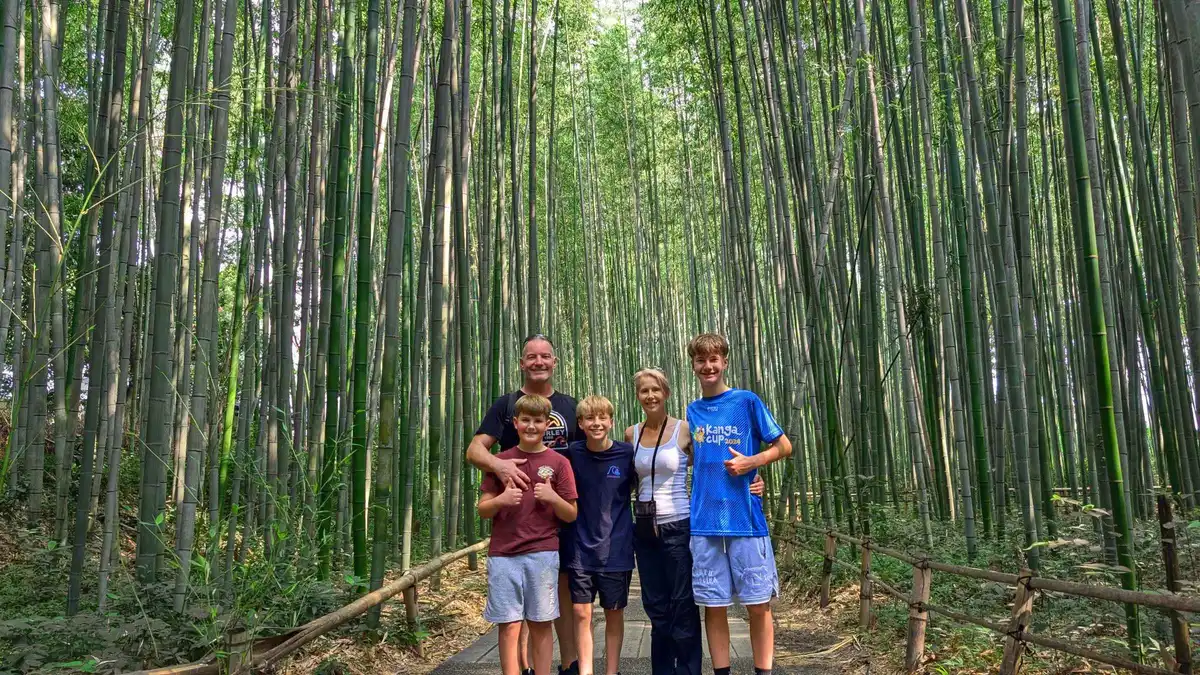
Most Booked — 4.86★, 938 Reviews Arashiyama Bamboo, Temple and Okochi-Sanso Walk — with Monkey Park or Sake Brewery
The most-reviewed guided walk on this page, run by Japan Tour Adventure. It is the only one that includes the ¥1,000 Okochi-Sanso Garden ticket, and after the grove…
- Okochi-Sanso Garden entry included: the ¥1,000 villa at the top of the grove
- Tenryu-ji and Iwatayama Monkey Park tickets included (Option A)
- Option B swaps the monkeys for a local lunch and Tanzan Brewery sake tasting
- Group or private booking at different rates
What You Are Looking At
Checked in August 2026. The installation is permanent and free, so nothing here expires except the tram fare.
Six hundred pillars, thirty-two patterns
The Keifuku Electric Railroad rebuilt Arashiyama Station in 2013 and used the work as an excuse to do something odd with the platform edges. The result is roughly 600 cylinders, two metres high, each holding a panel of textile dyed in the Kyo-yuzen technique that Kyoto has practised on kimono silk for three centuries. Clear acrylic protects the fabric; an LED inside lights it.
The fabric comes from Kamedatomi, a Kyoto textile house whose history runs back to the Taisho period, and the designer Yasumichi Morita selected 32 different patterns for the installation. Walk it slowly and the repetition breaks down: chrysanthemums, waves, pine, geometric komon that read as plain grey until you are a metre away.
| Detail | |
|---|---|
| Cost | Free, no ticket, no gate |
| Opening hours | None. It is open station ground |
| Pillars | About 600, each 2 metres high |
| Patterns | 32, dyed in Kyo-yuzen style by Kamedatomi |
| Installed | 2013, during the station renovation |
| Time needed | 10 to 15 minutes |
Go at dusk, not at noon
In daylight this is a pleasant corridor of patterned columns that most people photograph in thirty seconds and forget. After dark it becomes the thing worth the detour: 600 lit cylinders throwing colour onto grey paving, the tram pulling in behind them, and almost nobody there, because the coach groups leave Arashiyama by late afternoon.
Rain improves it more than any other spot in the district. Wet paving doubles the pillars, and the crowd thins to whoever is waiting for a tram. The awkward hour is high summer, when useful darkness does not arrive until well after 19:00 and the restaurants around the station have already closed.
The dragon pond, and the rest of the station
Among the pillars sits a small circular pool called Ryu no Atago, the dragon spot, treated as a place to make a wish for something you are working toward. It takes up almost no space and is easy to walk past.
The station itself is worth five minutes. A foot bath runs along one platform for tired walkers, the ticket office sells a day pass for the Randen line, and the retro-liveried trams that work this route are photogenic in a way modern rolling stock is not. This is the terminus of the Keifuku Arashiyama line, and the flat fare from central Kyoto is ¥250, about $1.60.
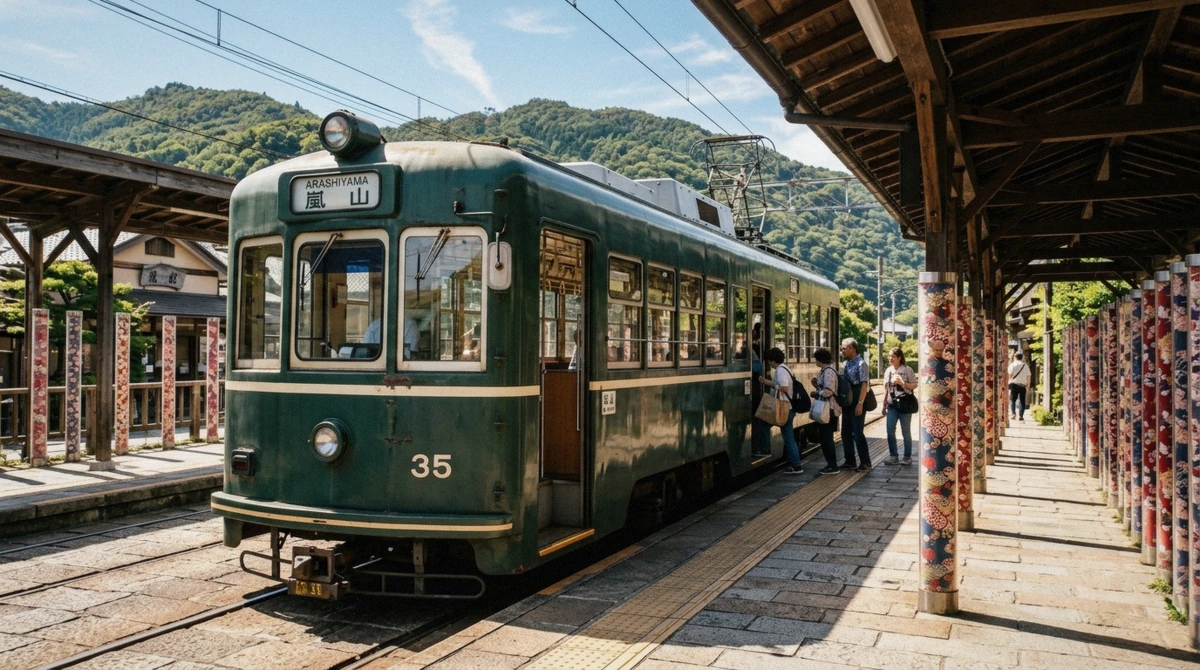
The Randen terminus. Flat ¥250 from town, and the pillars start at the platform edge.
Fitting it around the bamboo grove
The two sit fifteen minutes apart on foot, which makes the order obvious: bamboo in the morning when the path is empty, Kimono Forest at the end of the day when the lights come on. Doing it the other way round wastes both.
A sequence that works for a single Arashiyama day: grove at 8:00, Tenryu-ji at 8:30, Okochi-Sanso and the villa view mid-morning, the bridge and the monkey park after lunch, then back along the shopping street to the station for dusk. You end the day where the tram home leaves from, which is the part people usually get wrong.
Is it worth going for
On its own, no. Nobody should ride out to Arashiyama to look at a tram platform, and the installation takes less time than the journey. As the last stop of a day that started in the bamboo, it is the best free thing in the district after the grove itself.
The honest comparison is with what else costs nothing here: Nonomiya Shrine, the riverbank at Togetsukyo, the walk up through Sagano's back lanes. The Kimono Forest beats all of them after dark and loses to all of them at midday.
Where It Is
The pillars stand on the platform ground of Randen Arashiyama Station, at the town end of the main shopping street.
Questions About the Kimono Forest
Is Kimono Forest worth visiting?
As the last stop of an Arashiyama day, yes, and it costs nothing. After dark the 600 lit pillars are the best free sight in the district apart from the grove. As a destination in its own right it does not justify the trip out west, because the walk through takes ten minutes and there is nothing else at the station beyond a foot bath and a ticket office.
What is the Kimono Forest?
A permanent art installation at Randen Arashiyama Station: about 600 cylindrical pillars, two metres tall, each wrapped in acrylic over Kyo-yuzen dyed textile from the Kyoto house Kamedatomi. The designer Yasumichi Morita chose 32 patterns for it, and it went in when the station was rebuilt in 2013. Every pillar holds an LED.
Is the Kimono Forest free?
Completely. It stands on open station ground with no gate, no ticket and no closing time, so you can walk it at any hour, including after the last tram. You only pay if you are arriving by Randen, which is a flat ¥250 fare from central Kyoto.
How long does Kimono Forest take?
Ten to fifteen minutes to walk the full loop of pillars, including the Ryu no Atago pond and the platform. Photographers stay half an hour after dark waiting for a tram to pull in behind the lights. It is a stop, not an outing.
When do the Kimono Forest lights come on?
At dusk, which means around 17:00 in December and closer to 19:30 in high summer. There is no published switch-on time and no seasonal event attached to it, since the LEDs are part of the installation rather than a light-up festival. Rain makes it better by doubling everything in the wet paving.
How do you get to the Kimono Forest from the bamboo grove?
Walk. It is about fifteen minutes from the southern entrance of the bamboo grove, down through Nonomiya and out onto the main shopping street, which ends at the station. If you are coming from central Kyoto directly, take the Randen tram to its Arashiyama terminus and the pillars start where you step off.
Can you photograph it without crowds?
After about 18:00 the district empties and you will often have whole stretches to yourself, which is not true of anywhere else in Arashiyama. Mornings before 9:00 are also quiet but the pillars are unlit. Avoid the two hours after lunch, when every coach group in the district passes through on the way to the tram.